Close
Request a
Sample
Success
Our team will be in-touch shortly.
Oops! Something went wrong while submitting the form.
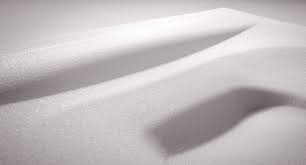


Thermoforming is a manufacturing process in which a thermoplastic material is heated until it becomes pliable, formed into shape, and then allowed to cool so that it retains the new geometry. Rohacell polymethacrylimide foam can be thermoformed into complex curved and three dimensional shapes when processed within a controlled temperature window.
Thermoforming is particularly well suited to thin walled or smoothly curved parts where conventional machining would result in excessive waste, long cycle times, or holding difficulties.
Rohacell becomes formable at temperatures typically between approximately 195 and 210 degrees Celsius. This temperature window is relatively narrow. Heating beyond this range risks surface degradation or charring, while insufficient heat prevents proper forming.
Accurate temperature control and consistent heating are essential for successful thermoforming.
The primary advantage of thermoforming is material efficiency. Curved or thin section parts that would otherwise require machining from thick blocks can be produced directly from sheet material close to final thickness.
Thermoforming also enables higher production rates. Cycle times are typically measured in minutes rather than hours, making the process attractive for medium to high volume production where part geometry allows.
Rohacell is hygroscopic and absorbs moisture over time. Material must be fully dried before thermoforming. If moisture is present during heating, it can vaporise and cause swelling, surface discoloration, and dimensional instability.
Drying is typically carried out in a convection oven prior to forming. After drying, material should be formed as soon as practical or stored in sealed moisture barrier packaging.
Once heated, Rohacell cools rapidly and remains pliable for only a short period. Transfer from the heating source to the forming tool must therefore be extremely fast to avoid cracking, particularly at edges.
Tooling should encourage smooth material flow and avoid sharp corners or tight radii. Non metallic tooling is often preferred to reduce heat loss during forming. Environmental factors such as drafts and cold air must also be controlled.
During thermoforming, the foam is stretched on the outside of bends and compressed on the inside. This distorts the cellular structure locally and introduces internal stresses that may result in springback once the part is removed from the tool.
Springback is influenced by material thickness, bend radius, forming temperature, and tool geometry. It is typically managed through controlled over forming and iterative tool development.
Thermoforming is often followed by trimming or finish machining to achieve final geometry. Because the majority of material shaping has already been achieved during forming, cutting loads are low and simple support tooling is usually sufficient.
Thermoforming can be combined with machining to balance material efficiency with dimensional accuracy.
Thermoforming Rohacell is a proven manufacturing method when moisture control, temperature management, tooling design, and workflow are properly addressed. In some applications, it is the only practical way to achieve the required production throughput.
Thermoforming expands the design possibilities of Rohacell by allowing it to function not only as a machined core, but as a formed structural element.
Thermoforming allows Rohacell to be shaped efficiently into curved and complex geometries while maintaining its structural integrity. When correctly implemented, the process delivers reduced waste, higher production rates, and consistent part quality.

We’re on a mission to support companies at the cutting edge of engineering and innovation by providing premium grade materials and precision cutting with short lead times.
If you would like a quote on any of Emkay Plastics products, or would like to request a brochure please give us a call or fill out details below and we will get back to you.